ONLINE educa is the world’s largest online learning-based event, which gathers experts in the field together to discuss current questions affecting the field. According to Brandon Hall, the focus in instruction is on relevant technical operational modes, real-time learning connected with work, and the utilization of web tools (e.g. blogs and wikis). InGilly Salmon‘s experience, teachers adopt new tools in use if they do not merely represent an end in themselves but in actual fact really improve quality and save time. Open content production is supported by, among others, Vijay Kumar(Massachusetts Institute of Technology); Over two million have already visited MIT’s pioneering Open Coursewareenvironment.
In teaching, video conferencing is a good tool. Kristi Jauregi Ondarra and David Sanz Pardo (Utrecht University) have enthusiastically applied it, successfully getting Spanish and Dutch students to work up text in pairs on the web. Operational modes for video in online-based materials have also also been studied by Helle Meldgaard ja Clive Young; in the presentation A Top 10 of Video Use in Higher Education, they assigned final place to the most prevalent method of application, i.e. “talking heads”.
Wim Veen‘s (Delft University of Technology) adventurous experiential multimedia presentation about the media culture of the new generation is an impressive demonstration of the fact that youth literacy is not deteriorating but is rather becoming more versatile: incoming messages from many sources can be successfully received and dealt with simultaneously. Learning has switched more and more outside the classroom, and “school is about meeting friends, not just learning”.
 |
 |
 |
 |
| Wim Veen’s presentation – including groups of rappers – was dazzling. Kristi Jauregi Ondarra also sparked admiration not only through her inspiring performance but with her highly workable concept of language-teaching as well. One again, Tampere was superbly represented, with TAMK University of Applied Sciences’ network specialists Marianna Leikomaa, Sanna Sintonen and Claudia Hallikainen. | |||


 supports the research of teaching technologies and their use in schools and colleges as well as in teacher training. In this year’s conference, e-portfolios, learning styles, network communities, building strategies for online courses and learning diaries were dealt with, among other things.
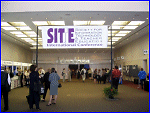 The most fascinating offerings were the talks connected with teaching styles, interaction and use of time. In relation to learning styles, the speakers favoured the “split portfolio” theory, i.e. they preferred the provision of many resources for various types of learners.
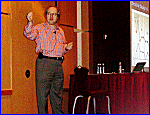 JAKOB NIELSEN
 he user is not questioned about experiences: rather, his/her actions are observed in the real environment. The user is also not taken along into the planning group, because this way s/he quickly changes his/her perspective, starts to understand the solutions made according to the terms of the system, and changes in this manner from a user into a planner. Observation provides more comprehensive information for cooperation than quantitative research, and according to Nielsen it is reliable, economical and a quick way to carry out development work. Tests should be performed at various stages of planning.


 The Prometheus conference was arranged 29 – 30 September in Paris. From the perspective of Yksityinen Kielitoimisto, the most fascinating content was provided by