Yksityinen kielitoimisto

  • Services
  • Resources
  • Publications
  • Conferences
  • About
You are here: Home / Archives for In English

What is Most Important to the Reader? – Place It in the Beginning

14.1.2017

What is the Purpose of the Text?

What do you have to say? Think about what the reader would like to know about the subject. Try to answer the reader’s needs speedily and thoroughly. This article is about how to write an online text which is quick to read.

Don’t Delay What You Have to Say

A good quality online text is usually built in the manner of a newspaper article where the most important material is placed first. You should write the most significant content at the beginning and continue to the less important parts – after that, you can return to the start and add an introduction. The introduction can then be used as a base for the headline, which should essentially offer a description of the story in a nutshell.
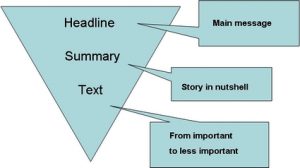
triangle

The Eye Follows the Left Side of the Text

The news story structure quickly answers the needs of an online reader. The point of the text is presented in the first few lines, and an impatient browser is not going to read much else. Jacob Nielsen has used a camera which tracks the eye movements and stated that electronic newsletters are read in an F-shaped pattern. The headlines and a few first lines are looked through, but after that the eye starts to slide down the left side without really stopping. So you should always pay particular attention to the headlines and the first words in a line of text.

Readability Above All

The writing should remain light both online and on paper. Without noticing it themselves, people are often tempted to write about their own field using jargon that may be incomprehensible to outsiders. You should look at your own text from the perspective of someone outside your group: abbreviations, terminology and long compounds are always less clearly understood than is assumed. Think and write practically: don’t talk about “media” if you specifically mean The New York Times.

Brevity is a virtue. Whenever possible, replace a long expression with a short one. Fight for every word and character. A compact piece of writing is always better than a fumbling long one. In particular, beware of strange, long compound words and the noun-heavy jargon style.

Practice by writing 140 character messages on the subject on Twitter. You’ll get great ideas for headlines as well as introductions – and you’ll notice that longer text is often unnecessary.

Filed Under: In English, In English, Makumatka verkkokirjoittamiseen, Spice Up Your Online Writing

Super Cool Hyper Link

13.1.2017

Online text consists of many independent parts that are linked together. The texts must be written in such a way that they work independently, but can also be easily linked to other pieces of writing.

For Those Who Need More Information

A link connects two parts of the content on one page, or two separate pages. Sometimes people talk about structural and associative links; the first serve the purposes of navigation and the latter offer additional information.

Links that give extra information can lead to either the content on your own page or somewhere else. It has become customary that internal links to your own website open in the same browser window, while the pages outside your website open to a new window – even though some usability experts have expressed differing views on the matter.

If the text is long, its usability can be enhanced by adding a linked list of contents. The subtitles come straight after the main headline – usually one below the other and sometimes side-by–side, separated by a vertical line. A list of contents takes up some of the precious space from the top of the screen, but it offers the reader the possibility to pick up the information he needs without scrolling down the page.

Link Your Key Words

When naming your links, you should follow a consistent practice: you can lead to pages by using only the name or an address – or both. The first alternative is the easiest for the reader, however. While thinking about naming the links, you should focus on what best serves the reader. Keywords support skimming very well, while long links make the text seem patchy, while choosing only pronouns offer poor predictions for content. For example: “You can read about Twitter here” should be changed to “Are you interested in Twitter?

You should provide enough clues in your text to show what the content of your link is. The better the reader is able to predict the content opening with a link, the less there will be unnecessary clicking. Transparent links, names and titles make the text more usable.

Spice Up Your Online Text with Links

Links that offer additional information are a part of web texts and should not be avoided. However, they should be chosen with care. You’ll find that general explanations, argumentation, examples and new perspectives are useful extra material. Even so, it’s better to offer a few specific links rather than ten random ones as well as clarify their purpose. The links should naturally also be functional and up-to-date – it’s extremely frustrating to click on a link and find that it’s missing or ‘dead’.

Students are often offered additional material in other file formats. The essential content of these should provide a short explanation on the web text, so that the reader can predict whether the file should really be opened or not. The link of the file should make clear what the form of the file (pdf, doc, ppt, etc.) and its size are – for example, IT vocabulary (Word document, 24 kbts).

Filed Under: In English, In English, Makumatka verkkokirjoittamiseen, Spice Up Your Online Writing

Does Your Tone Encourage Conversation?

12.1.2017

Two-way interaction is at the core of social media. Following and sharing information go hand-in-hand. If you don’t have the time to follow what other people are saying, you won’t be able to fit your own message into the conversation.

Be Genuine and Positive

Controlling the tone of the messages is an important skill if you mean to be active online. As general advice, one could say that positivity and willingness to interact suit the web as well as other kinds of communication. Honest dialogue which impartially considers different opinions is the most useful for all parties.

Messaging in social media is often placed somewhere between speech and writing. In speech, various tones can be expressed in many ways, but in written dialogue the way of saying things easily becomes monotonous. Naturally the tone control varies between different writers, but the tone of one individual writer is surprisingly permanent. It’s interesting to study both your own and others’ messages, while keeping in mind the question of tone: how do the various expressionsfeel? With respect to tone, it isn’t important to be concerned about the literal content of the message, but rather what it feels like.

Humour is difficult to master, but some levity is always called for. The advantage of humour is that it allows you to keep a healthy distance, but in an emergency excess tension can be loosened with asmiley. You can forget about unnecessary pomposity as studies prove that the more you let your personality show, the more interesting you become in an online environment.

Read and Re-Read Every Message and Answer

You should always make sure that you start and finish your messages in a friendly way, because negativity only tends to aggravate others. An instructive, authoritative style of presentation in the manner of “this is how it is” comes across as stifling, while the same content formulated “I think this is how it is” invites participation. Your tone is generally made better if you have the patience of mind to read other people’s messages a few times and not react too quickly. It is often beneficial for the atmosphere of the conversation to cite the responses others have given and thereby prove that you’ve read and understood them.

Directing interaction takes skill, as it should be done in the spirit of free conversation without a teacher-like attitude and authority. The participants should be given time to form their opinions so that the first and last comment don’t always come from the teacher. Flexible communication is supported by an atmosphere that promotes contemplation – where the aim is not in getting right or wrong answers, but a conversation having many voices.

Are Online Conversations Impartial?

Online interaction has been interpreted as more democratic and less tied to the speaker’s social position than face-to-face conversations. The matter does however call for more thorough investigation, because more and more often – even on specialist message boards – you will run into participants who feel that their comments have been ignored. Power settings have an impact online too, but they are not necessarily formed in the same way as in face-to-face communication.

A new feature in social media communication is its multi-centeredness as well as publicity, which make the conversations more varied but also demand that you learn the rules of public conversations and the proper netiquette. The quality of the conversation is usually improved if you use your own name or you’re able to connect the user name with the right person.

Filed Under: In English, In English, Makumatka verkkokirjoittamiseen, Spice Up Your Online Writing

Interact and Express Yourself

11.1.2017

In his study In the Borderline of the Traditional and Social Media, Janne Matikainen examines why people bother to write for free in blogs and online communities. Earlier studies have emphasized the need for attention, but now the more important reasons were revealed to be self-expression, interaction with others and the implementation of web ideology. The roles of producer and consumer are mixed in social media, and active online communities have no need of the old media gate keepers.

Make Yourself Heard with a Blog

Clearly there has been a need for dialogue which complements main stream media, when you think, e.g. about the massive quantity of blogs. There are an estimated hundred million blogs in the world – and new ones are being created every second. The comments and connections – or the way blogs converse with each other – are as important as the blogs themselves. At its best, a blog community is a medium of alternative conversation which complements mainstream publicity. It is exciting that Jukka Kemppinen – or any popular blogger – can receive dozens of comments.

A blog has to be interesting to attract readers, but how to write appealing blog posts? First and foremost, you should have something to say and you should have the courage to state your case decisively. A clear message expressed in a concise manner suits blogging. Your own personality and voice can be heard in the text, and the readers can be activated to leave comments, for example, with open questions.

The Popularity of Short Updates has Increased

The peak popularity of blogs seems to be fading, however, because young people in particular prefer to use microblogs for shorter updates. Even so, Twitter can also be used to promote longer blog posts. You can pick some questions or statements that might get readers on the hook and shape them into Twitter messages. You can then link the message to your blog post. In the ideal situation, your clues are somehow connected with a conversation that is already ongoing. You can also practice how to formulate a good Tweet.

Facebook updates are very similar to Twitter messages. Brevity and participation are virtues when updating, but the tone of the conversation is normally more entertaining on Facebook, which should be considered. The benefit of Facebook is a wide user base which shows in the number of comments. When I have crowdsourced a problem simultaneously on Twitter and Facebook, the first one usually produces four or five answers and the second usually several dozens.

You’ll learn to write interesting messages by practising and analyzing good texts. The next slides give you some good tips, even if the presentation is based on marketing. After all, marketing skills do no harm to us as teachers either, do they?

Filed Under: In English, Spice Up Your Online Writing

The word of the week is sales quote.

9.1.2017

Last week I worked with a car dealer on electronic communications. Car salespeople are skilled professionals in face-to-face settings, but sales through writing can feel unnatural to them. When they’re working in person with a customer, features, benefits, and counter-proposals flow freely, but in email, the salesperson’s vocabulary drops to just a few works. “Quote attached.”

What makes a strong selling reply to a customer query? The customer needs to feel that she’s been heard, which is why the salesperson must carefully address each of the customer’s questions. It’s no disgrace for the salesperson to show that effort has gone into the reply. “I checked with other dealerships and found the model and color you wanted.” Just as with speech, in writing the successful salesperson presents the strongest sales proposition, supported by relevant features (“low mileage and only one owner”) and details (“fully serviced just last month”). All potential buyers are interested in price, and that figure shouldn’t be hidden. At the same time, the salesperson can set it in the most advantageous context.

Most important, the seller should invite the customer to take the next step toward a deal. (“I can have the car ready for you as soon as Tuesday.”) A firm offer from the buyer is terrific; a good relationship between buyer and seller makes an offer more likely. It’s easier for someone to say no to an impersonal dealership than to an actual dealer who’s written in a engaging, human tone.

Filed Under: In English, Word of the Week

The word of the week is Wagga Wagga.

26.12.2016

In Australia, an occasional traveller was surprised by the large number of non-English place names: Coogee, Geelong, Jamberoo, Morawa, Yarraand so on. Particularly playful-sounding were replicated names likeBallaballa, Grong Grong, Kurri Kurri, Wagga Wagga and rhymed ones like Arrawarra, Turramurra, Tumbi Umbi. Replicated names were so common that questions arose whether they had some grammatical significance. It turned out that plural is expressed by repetition. For example “Wagga” has originally meant ’crow’ and Wagga Wagga ’many crows’, and in turn, Baw means ’echo’ and place name Baw Baw ’echoes’. Has English borrowed other words from Australian Aboriginal languages? Not many, but they are very familiar: kangaroo, koala, dingo, boomerang. All of these, of course, I had to look for on my trip to Australia.

Filed Under: In English, Word of the Week

The word of the week is RR.

19.12.2016

Medical records for patients contain a lot of specialized terms and abbreviations. Surprisingly, only a few people complain about the documents that track their health, even though it’s often difficult to determine the severity of their condition or the proposed treatment. While at the doctor’s, people have the opportunity to ask for clarification, but sometimes questions don’t come to mind, or the answers are forgotten. For issues as vital as health, a person should be able to access and explore his information in plain language whenever it suits him.

Technical terms and abbreviations appear in such documents, even those intended for a patient, when ordinary English equivalents exist: otitis ‘ear infection’, anorexia ’eating disorder’, phobia ‘fear’, amnesia ‘memory loss’, pyrexia ’fever’. A patient can easily make a mistake when the prescription reads prn, sl, or ac. Confusion can also arise from diagnoses. One concerned patient returned to the hospital to ask about “elevated RR” that she seemed to be suffering from, along hypertension – because her patient history didn’t make clear that both terms refer to high blood pressure.

Filed Under: In English, Word of the Week

The word of the week is spoken language.

12.12.2016

Spoken language and written language are very different things, as you can tell by reading a transcript of actual speech. The spoken word is fragmentary, with lots of repetition, rephrasing, and filler: Do these points… I mean, are these good ones to start with, you know, or what. Speech doesn’t use punctuation, and long strings of words are loosely connected with ”and” or other conjuctions. Often, though, employees transcribing health care dictation from recordings are told to reproduce the speech without any modification. Following that guidance literally would make the instructions very hard for a reader to follow. Journalists, in the same way, are supposed to faithfully report exactly what an interviewee says, even though a word-for-word account in print can make the speaker sound illiterate.

Elsewhere, instant messages, are becoming more like natural speech:Nearly finished reading them they’re cool don’t remember titles I read didn’t read first one. It’ll be interesting to see if this transformation expands to other forms of writing.

Filed Under: In English, Word of the Week

The word of the week is bromide.

5.12.2016

According to the dictionary, a bromide is an uninteresting, obvious truth. I encountered a flock of bromides last week while reading a hefty package of EU funding instructions. The instructions are lengthy and ponderous. Along with other baggage, they contain such bromides as “a business startup grant may be issued to start up a new business” and “natural disaster compensation is intended to compensate for damage caused by natural disasters.”

Why do instructions so often start this way? Probably it’s an opening format borrowed from nonfiction writing. The authors may believe than regardless of topic, they should start with a definition — even if it doesn’t add anything. This style crops up in other public-sector writing: “Compensation includes salary and other considerations” and “Employees under certain conditions are entitled to holidays and vacations.”

A definition is one way for a writer to get started, but obvious or unnecessary ones just clutter up the narrative. Even this short piece began with a definition — was it a bromide?

Filed Under: In English, Word of the Week

The word of the week is Rosetta stone.

28.11.2016

What is common with the Rosetta stone and social media? The mystery of hieroglyphs was solved with the help of the Rosetta stone. The same legal text was written on the stone with hieroglyphs, demotic script, and Greek. The Greek writing allowed scientists to interpret the hieroglyphics in the 1800s; the skill which had been lost since the use ended 300 years AD.

Social media can act as a Rosetta stone in opening difficult official documents. While studying how municipal documents were edited to online texts, it appeared that the readability improved, as the original text was rewritten to newsletter and when the newsletter in turn was modified to social media update. A plain language update can therefore serve as a key for a reader to difficult public sector writings and increases opportunities for meaningful participation. In addition, active government communication is likely to renew official language itself, and thus to improve also the readability of original documents.

Filed Under: In English, Word of the Week

  • « Previous Page
  • 1
  • …
  • 9
  • 10
  • 11
  • 12
  • 13
  • …
  • 27
  • Next Page »

Search

    Request a quote.

    We offer training on writing, communications, e-learning and social media.

    Yksityinen kielitoimisto

    Tampere
    Puh. 040 5702 901
    info@yksityinenkielitoimisto.fi© 2026 · Yksityinen kielitoimisto · Sollertis

    • Suomi
    • English